At a Glance
- Client
- Crimson Tree Software
- Product
- TIERS
- Audience
- Elite tax teams managing complex partnership structures and reporting
- Work
- Website strategy, information architecture, messaging, visual design, product education, and development
- Primary goal
- Explain TIERS' glass-box architecture, help qualified visitors inspect the platform, and turn meaningful interest into product briefings
- Result
- A custom website, a full-capability Demo Library, and three Platinum 2026 dotCOMM Awards
The Assignment
Crimson Tree Software builds TIERS for tax teams solving some of the most difficult problems in partnership tax.
An engagement can involve deeply tiered ownership structures, millions of allocations, federal, state, and international reporting, K-1 and K-3 production, compressed deadlines, and a long trail of numbers that someone must be able to explain.
The people evaluating TIERS are accustomed to asking:
- Where did this number come from?
- What changed?
- Can the calculation be reproduced?
- What work belongs to AI, and what remains under professional control?
- Can this platform handle the scale and complexity of our engagements?
The website needed to show its work, too.
Starting with a Strong Site and Asking More of It
Crimson Tree's previous website was a visually striking Squarespace site. It gave the company a credible presence and introduced the TIERS product story.
The next stage called for a custom experience with more room for interaction and product education. Crimson Tree also wanted to use Second Wind, its own enterprise AI orchestration platform, as part of the design and development process.
The new site needed to:
- Explain the relationship between TIERS' deterministic calculation engine and its AI-assisted operations
- Give visitors access to real product interfaces
- Organize a growing collection of demonstrations and client evidence
- Reflect Crimson Tree's long engineering history
- Help qualified visitors decide whether to request a briefing
- Give the Crimson Tree team a flexible foundation for future product stories
Letting Evaluators Choose How Deeply to Explore
We designed the site around a progression from orientation to evidence.
The homepage introduces Crimson Tree's position, explains the architecture behind TIERS, establishes the company's engineering history, and presents three working parts of the platform:
- A dynamic organization chart for navigating complex partnership structures
- K-1 variance comparison for seeing what changed and tracing why
- A state apportionment matrix for federal and multistate calculations
Each capability leads naturally into the larger Demo Library.
Visitors who need a quick understanding can remain on the homepage. Those evaluating a specific workflow can go directly to the relevant demonstration. Those with a real problem to solve can request a briefing.
The path through the site became:
- Understand the system.
- Examine the evidence.
- Explore the product.
- Decide whether it is time to talk.
Making the Glass-Box Architecture Visible
One of the central communication problems was explaining how TIERS uses AI without implying that probabilistic AI controls the tax calculation.
TIERS keeps tax calculations inside a deterministic engine. AI assists with preparation, explanation, diagnosis, and review around that engine.
The homepage uses custom cards and lightweight animation to make the division of responsibility visible. The "Burden of Proof" experience shows how an output can be followed through its underlying data and allocation path.
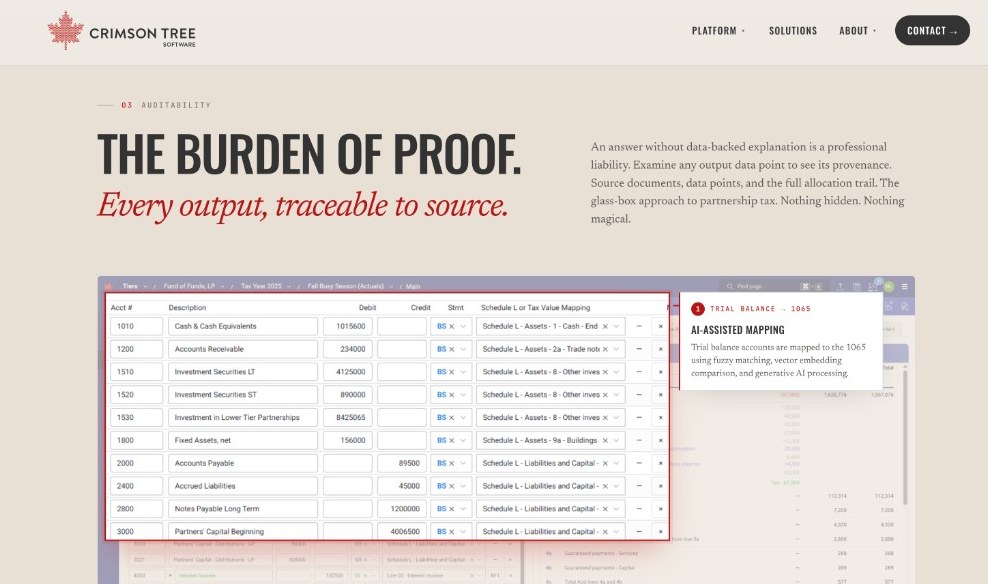
This distinction is particularly important for the site's audience. A plausible answer is not enough in partnership tax. The calculation must be reproducible, and the professionals responsible for it need to understand how the system reached the result.
Replacing Abstract Claims with the Working Product
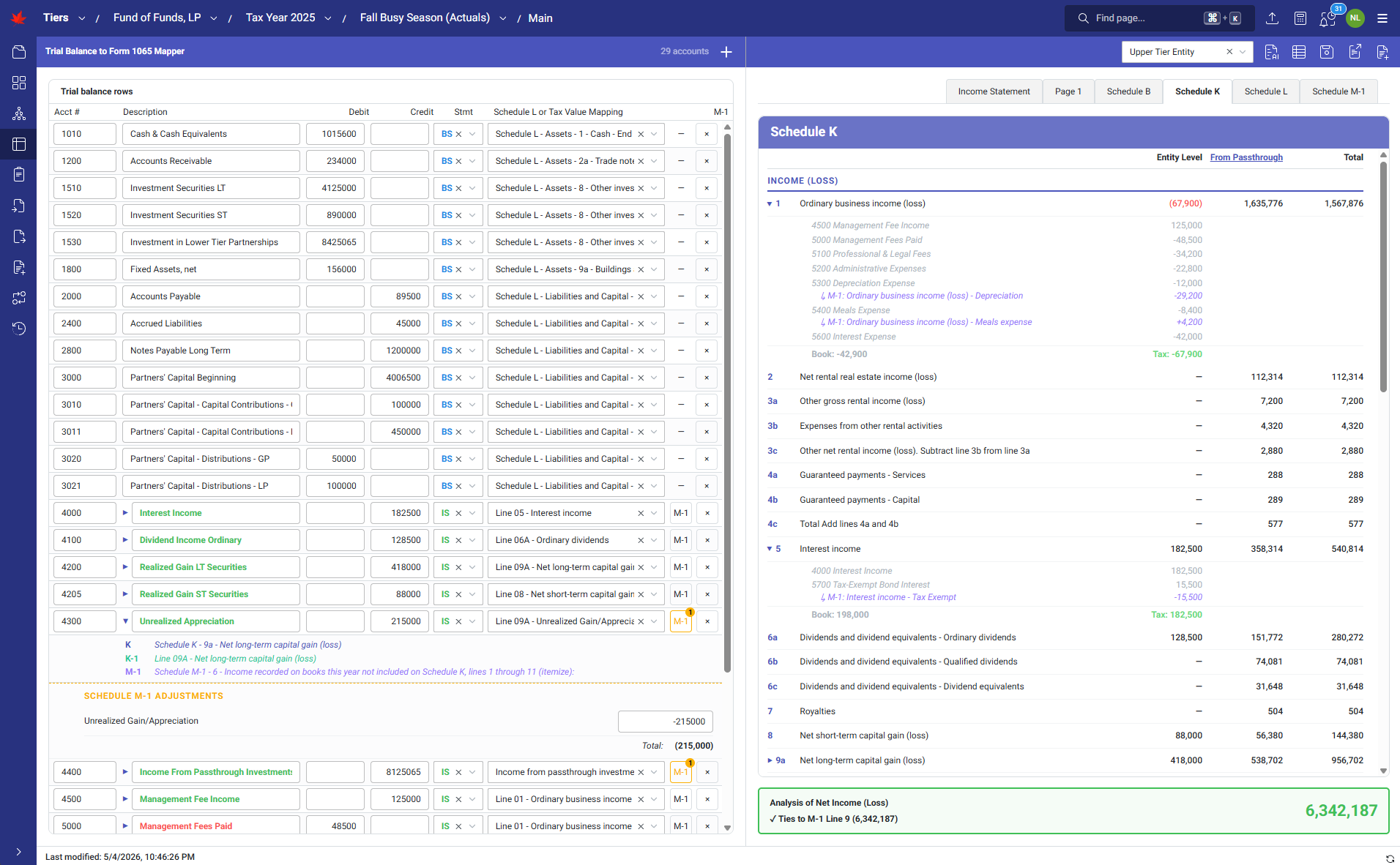
The redesigned site uses actual TIERS interfaces instead of generic technology illustrations.
A custom guided tour gives visitors a closer look at the trial balance mapping experience through focused callouts, autoplay, zoom controls, keyboard navigation, and accessibility support.
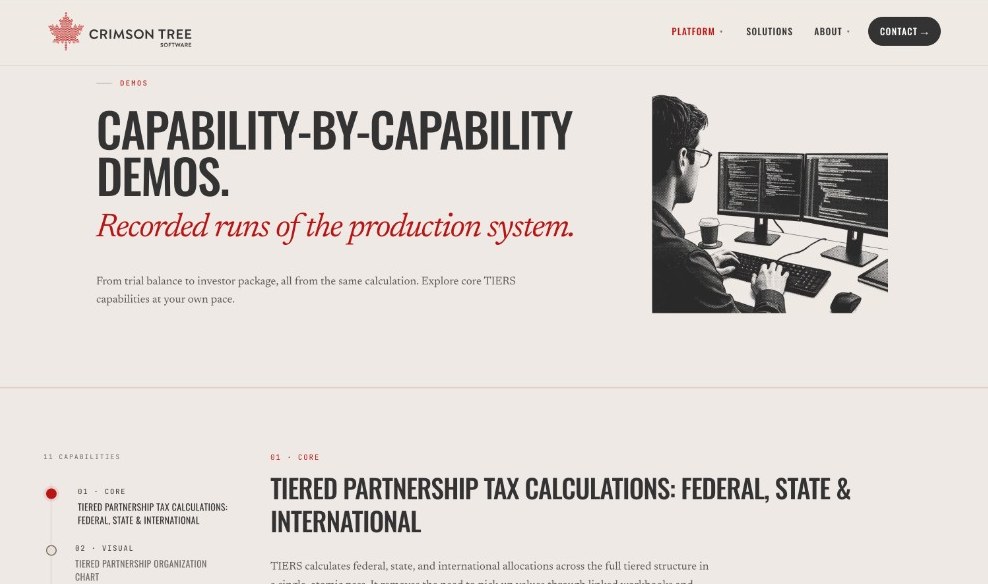
The full-capability Demo Library goes further. It includes production screenshots and recorded runs covering:
- Tiered federal, state, and international calculations
- Partnership organization charts
- Trial balance mapping to Form 1065
- Multi-user branching and merging
- Partnership tax tables, pivots, and exports
- K-1, K-2, and K-3 production
- K-1 variance comparison
- Audit history and point-in-time restore
- State apportionment
- Engagement dashboards
Each capability has a dedicated page with explanatory copy and enlarged product views. Permanent URLs allow someone to share a specific demonstration with colleagues rather than asking an evaluation team to find it again.
The Demo Library gives visitors room to investigate TIERS on their own terms before entering a sales process.
Designing for an Audit-Minded Audience
The visual system takes its cues from the working world of tax and accounting rather than from conventional SaaS design trends.
Cream paper, dark ink, crimson "auditor's red," ledger rules, numbered sections, and editorial typography create a restrained enterprise identity. Oswald provides structure, Newsreader supports the editorial narrative, and JetBrains Mono carries technical details and data-oriented elements.
Long pages follow ledger-like vertical rules marked by crimson nodes. These help readers keep their place while moving through the story. Real TIERS screens, named client perspectives, and traceable demonstrations keep the evidence nearby.
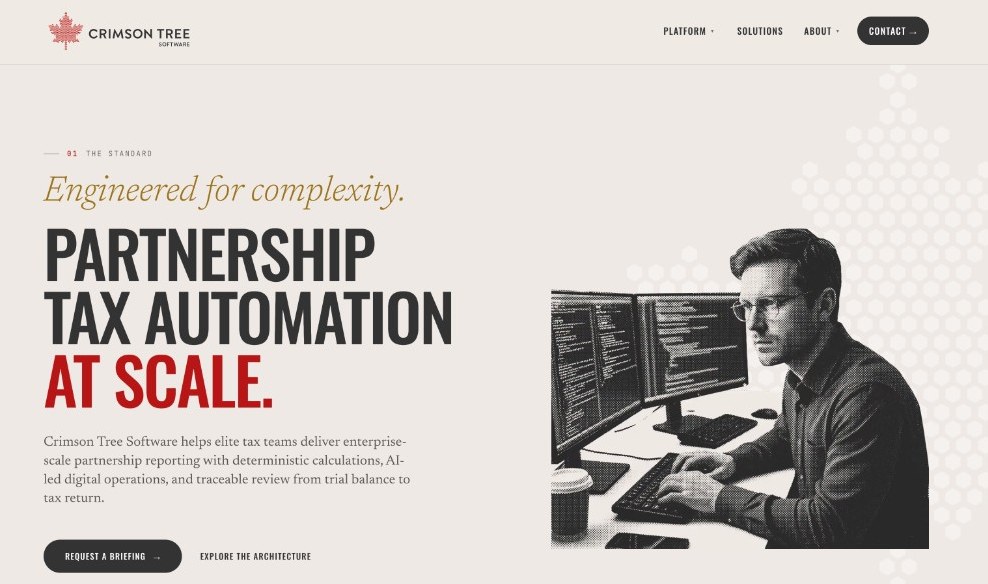
Custom illustrations add a human presence to that technical structure. The homepage artwork places a tax professional at work across two monitors, actively using the system rather than posing beside it.
The human figures also express part of the TIERS philosophy. Calculations can be automated, and AI can assist with preparation and review, but people remain responsible for understanding and defending the work.
The result feels familiar to professionals who review workpapers, trace calculations, and ask where every number came from, while still giving Crimson Tree a visual identity of its own.
Connecting Product Exploration to a Briefing
The website gives prospective buyers space to do some homework before contacting Crimson Tree.
By the time someone reaches the briefing request, they may already have:
- Reviewed TIERS' glass-box architecture
- Examined real product interfaces
- Explored the company's engineering history
- Opened demonstrations related to their own work
- Shared individual capabilities with other evaluators
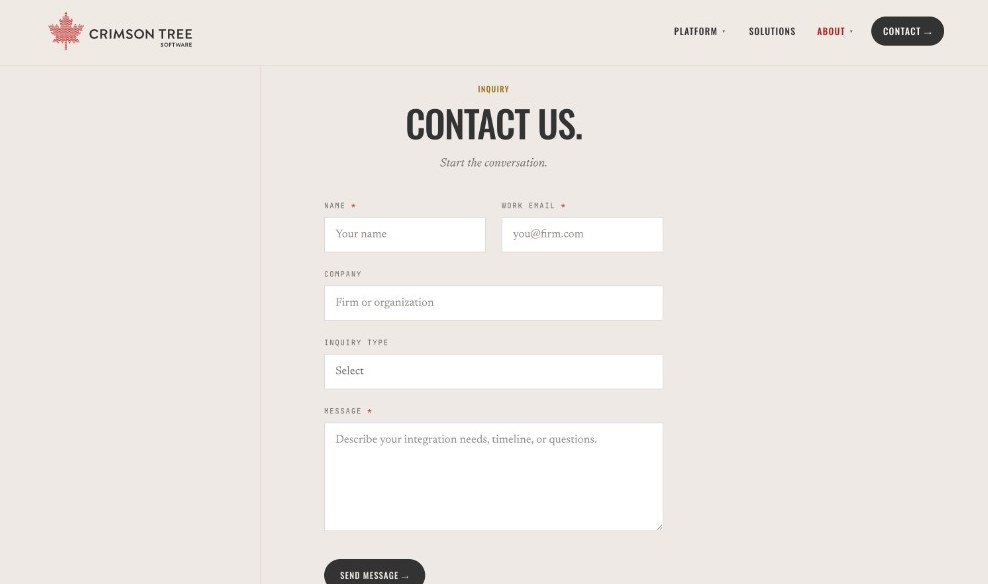
The contact experience lets visitors describe what they are trying to solve. Submissions trigger immediate notifications in Crimson Tree's communications channel so the appropriate team members can respond while the inquiry is still fresh.
Privacy-conscious analytics, search foundations, performance work, accessibility support, and redirects from legacy URLs complete the less-visible part of the rebuild.
How We Built with Second Wind
The website was conceptualized and built in collaboration with Crimson Tree's own enterprise AI orchestration platform, Second Wind.
Second Wind worked alongside the Stealth Cartel and Crimson Tree teams throughout the project. It supported research, exploration, content development, critique, and implementation decisions.
Claude contributed to early concept and design exploration. Cursor supported production development.
The process still included multiple wireframe rounds, design revisions, product reviews, and many moments when the work was close but not quite right. Stealth Cartel and Crimson Tree remained responsible for the positioning, product truth, visual decisions, and final approvals.
The working model reflected the philosophy being communicated on the site: give AI meaningful work while keeping people responsible for the decisions.
The Outcome
The redesigned website brings Crimson Tree's engineering history, product architecture, real interfaces, client evidence, and path to a briefing into one connected experience.
It gives different visitors different ways into the TIERS story:
- A concise homepage for initial orientation
- Working interfaces for buyers who want product evidence
- A full-capability library for detailed evaluation
- Shareable demonstration pages for buying groups
- A briefing request for teams with a real use case
In July 2026, the work received three Platinum dotCOMM Awards:
- Business to Business
- Website Home Page Design
- Website Redesign

The awards provide welcome external recognition. The more important result is a website that lets serious buyers understand more of TIERS before their first conversation with Crimson Tree.
For Stealth Cartel, the project reflects a principle that applies across complex B2B markets: design should help buyers understand the product, examine its claims, and make a better decision.